
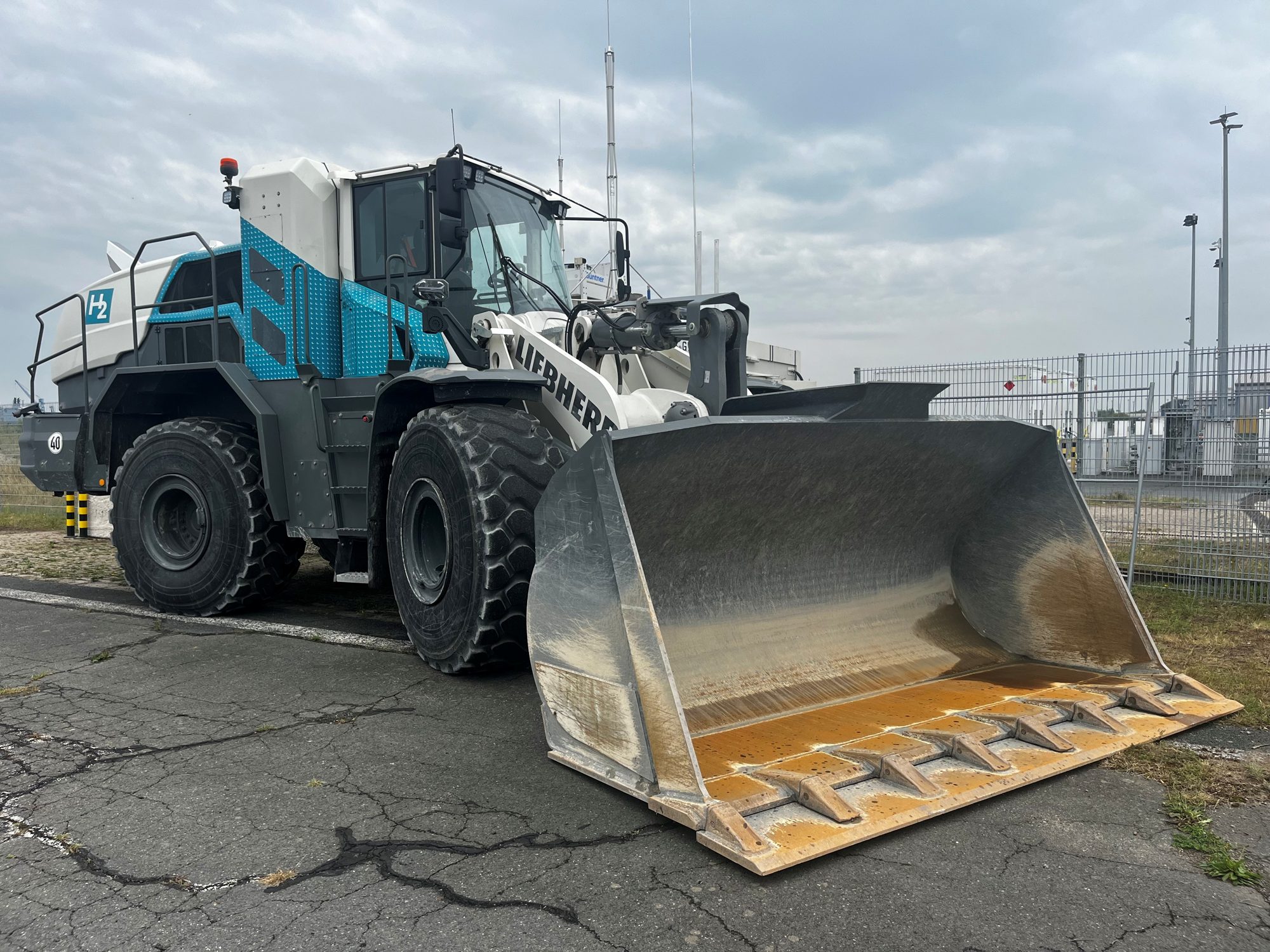
Test in Bremerhaven: Heavy-Duty Machine Runs on Hydrogen
H2 Wheel Loader Starts Operations in the H2B:IMPACT Project
Clean propulsion for heavy machinery: This is the idea behind a new test project getting underway in Bremerhaven’s fishing port. Liebherr has brought a large hydrogen-powered wheel loader to the Weser for the trial.
By Ursel Kikker – 7 October 2026
“Green” hydrogen (H₂), produced using renewable energy, is at the heart of a trial in Bremerhaven’s fishing port aimed at demonstrating its potential as a climate-friendly fuel for construction machinery. Together with civil engineering company Georg Grube, vehicle manufacturer Liebherr will test a large, heavy-duty wheel loader powered by a hydrogen engine in everyday operations over the coming months.
The green hydrogen produced using renewable electricity is supplied by Green Fuels GmbH, based in Bremerhaven. Its Managing Director Andreas Wellbrock brought the project partners together.
“The fishing port is an ideal test location,” Wellbrock is convinced. “On the one hand, companies here have a strong interest in the topic; on the other, there is already good infrastructure for supplying green hydrogen.”
Dedicated hydrogen refuelling station set up
Originally, the project partners planned to operate and refuel the XXL wheel loader at a sand extraction site in the Cuxhaven district. However, this proved technically unfeasible because the required power connection was not available.
A hydrogen refuelling station has now been installed near Grube, at the Hydrogen Lab test site operated by Fraunhofer IWES on the former Bremerhaven airport site. A hydrogen production facility is also operating in Bremerhaven-Speckenbüttel beneath a wind turbine.
The 3.25-metre-wide wheel loader travels from Grube’s site on Dockstraße along an existing heavy-load transport route to the refuelling station at the former Luneort airfield.
The hydrogen refuelling station near the Zentrum motorway exit was not considered a viable alternative. The route would have been too long, and because the machine is 3.25 metres wide and weighs several tonnes, it would have required regular transport on a low-loader and special permits, Wellbrock explains. That would not have been practical.
Wheel loader put to the test in everyday operations
The large Liebherr wheel loader is being used as part of a trial funded by the Clean Hydrogen Partnership of the European Union. According to Wellbrock, the machine is a prototype from Austria. It is considered to be the world’s first vehicle of this type equipped with a hydrogen internal combustion engine.
With an operating weight of between 24 and 32 tonnes, the wheel loader will be tested under regular, continuous operating conditions at Grube to assess its suitability for everyday use.
Like many other industries, the construction sector is facing the challenge of operating its machinery and vehicles in a climate-neutral way in the future.
“Green hydrogen is a promising option for this,” Wellbrock says. Given the weight and loads that these vehicles have to move, battery-electric alternatives would not be suitable, he argues.
New project at the test site
Following an initial series of tests in Austria, Bremerhaven was selected as the test location because of the good hydrogen infrastructure available in the fishing port.
“It was also a key factor that an entrepreneur such as Wolfgang Grube is active here and is very open to the topic,” Wellbrock is quoted as saying in a press release.
As the operator of the Fischereihafen commercial and industrial area, FBG Bremerhaven was also involved in the project. The company granted special permission for the use of the heavy-load transport routes within the test area.
The wheel loader will have to travel regularly from Grube’s premises to the hydrogen refuelling station.
“This project supports the initiative of businesses in the fishing port to implement concrete measures to reduce CO₂ emissions,” says FBG Managing Director Petra Neykov.
Andreas Wellbrock and his partners aim to demonstrate that hydrogen can also be used as a fuel in the construction industry.
Image source: © Green Fuels GmbH